Text
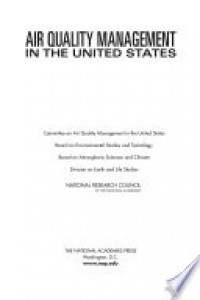
Air quality management in the United States. Committee on Air Quality Management in the United States, Board on Environmental Studies and Toxicology, Board on Atmospheric Sciences and Climate, Division on Earth and Life Studies.
Recognizing the central role that science and engineering plays in air
quality management and anticipating the next congressional reauthorization of the Clean Air Act and its amendments, the United States Congress
directed the U.S. Environmental Protection Agency (EPA) to arrange for a
study by the National Academy of Sciences (1) to evaluate from a scientific.
In addition to the information from those presentations, the committee
made use of the peer-reviewed scientific literature, government agency reports, and unpublished databases, as well as related statistics and data directly obtained from EPA.
This report consists of seven chapters. The first chapter provides an
overview of the committee’s charge, the issues related to this charge, and the
approach the committee took in completing its task. Chapters 2–6 review
the current air quality management system in the United States and assess
how well this system is operating. Chapter 7 looks to the future; it identifies
the major air quality challenges the nation is likely to face in the coming
decade and advances a set of five interrelated recommendations for enhancing the nation’s air quality management system to meet these challenges.
The Executive Summary provides a brief overview of the committee’s findings and recommendations. The more-detailed Summary is presented immediately after the Executive Summary. Readers who are well versed in the
current operation of air quality management in the United States or who do
not need to become well versed may wish to move directly from the
Executive Summary or Summary to Chapter 7. The recommendations in
Chapter 7 relate to Chapters 2–6, where the detailed background information and justification for the recommendations are provided.
and technical perspective the effectiveness of the major air quality provisions of the Clean Air Act and their implementation by federal, state, tribal,
and local government agencies; and (2) to develop scientific and technical
recommendations for strengthening the nation’s air quality management system with respect to the way it identifies and incorporates important sources
of exposure to humans and ecosystems and integrates new understandings
of human and ecosystem risks. In response, the National Research Council
established the Committee on Air Quality Management in the United States,
which prepared this report. Biosketches of the committee members are presented in Appendix A
Ketersediaan
| P00019S | 363.739 Nat a | Tersedia |
Informasi Detail
- Judul Seri
-
-
- No. Panggil
-
363.739 Nat a
- Penerbit
- Washington, DC : The National Academies Press., 2004
- Deskripsi Fisik
-
xxiii, 401 pages
- Bahasa
-
English
- ISBN/ISSN
-
0-309-51142-9
- Klasifikasi
-
363
- Tipe Isi
-
-
- Tipe Media
-
-
- Tipe Pembawa
-
-
- Edisi
-
-
- Subjek
- Info Detail Spesifik
-
-
- Pernyataan Tanggungjawab
-
National Research Council (U.S.).
Versi lain/terkait
Tidak tersedia versi lain
Lampiran Berkas
Komentar
Anda harus masuk sebelum memberikan komentar
 Karya Umum
 Filsafat
 Agama
 Ilmu-ilmu Sosial
 Bahasa
 Ilmu-ilmu Murni
 Ilmu-ilmu Terapan
 Kesenian, Hiburan, dan Olahraga
 Kesusastraan
 Geografi dan Sejarah